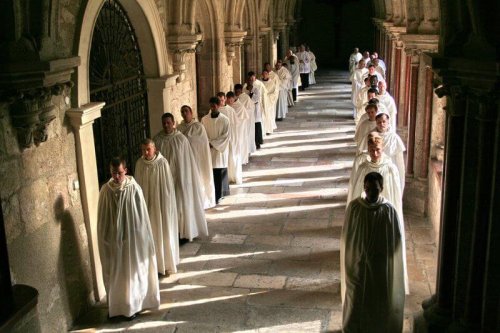

“To make oneself a stranger to the actions of this age (Saeculi actibus se facere alienum)”(RB 4:20)
St. Benedict finds those who are to become his followers in the midst of the multitude of people (Prol. 14), but in calling them to undertake the journey to the kingdom (Prol. 21), he necessarily invites them to come out from that multitude. Henceforth “this world” or, better, “this age” – Benedict uses saeculum rather than mundus – becomes a symbol of apostasy. “This age” and all its works are what we have left behind in following our vocation. What is beyond the monastic sphere of influence is not good for our souls (66:7), it is destruction (destruction; 67:5). The danger, however, is not the world outside, as it were the Goths at the gates, but the world brought inside the monastery in the heads and hearts of monks and nuns.
It seems to me that the first and foremost call that comes to us today from Benedict’s Rule is to become what we are meant to be. To embrace whole-heartedly our Benedictine and monastic identity, and to assert our distinctiveness in respect of “this age,” the ambient culture that espouses so very few of the values that characterize our seeking of God. Our citizenship and conversation are heavenly (Phil. 3:20).
Despite the fact that a previous Abbot Primate has stated that Benedict “has no place for fuga mundi,” it is only by keeping a certain distance from society that we can hope to have some positive impact on it. The Gospel images of salt and leaven are reminders to us that our influence depends on our being different, on our remaining faithful to our vocation to be distinctive. “Salt is a good thing, but if salt becomes unsalty, how can you season it?” (Mk 9:50). Abbot Parry pungently restates this ancient idea.
The need to break visibly with the ways of the world, and to assert something more definitely by one’s life-style, becomes more and more urgent as our society plunges morally into the abyss, and socially into disruption. The need is for witnesses whose witness is both intelligible and unmistakable, for witnesses who know how to reject and rebuke evil however disguised, and likewise proclaim what is good.
This assertion of identity must be more than mere “contempt for the world,” although some may believe that today there is much in many societies that is contemptible. It must derive from a certain clarity about our ultimate ideal and our goals, and also about the means necessary if we are to form succeeding generations so that they have some chance of persevering in their quest for God.
– M. Casey, Strangers to the City 1-2
“The single means of access to all that is good is Jesus.” (Barrett, Gospel 373)