“Give me three loaves. Friends have come to us from their
journey and I have nothing to set before them.” (Lk 11:5)
“Brethren, I am asking for these loaves for your benefit; I am asking because of your merits. But do you think we are equal to them? Will I be able to break them? Will you be able to eat them? …
Who is able to understand? Who can explain? Or who can meditate worthily on the ineffable mystery of the Blessed Trinity? How the Father is of himself alone, the Son is from the Father and the Holy Spirit is from both Father and Son, and how there are three Persons in a unity of substance…. Enough for me to know of their existence and that they are three in number….
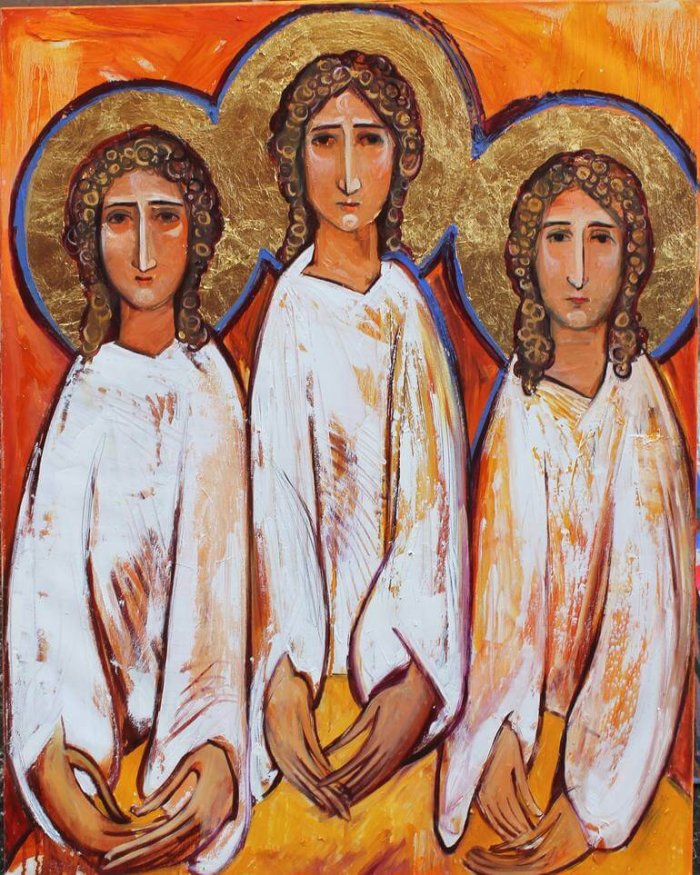
So let us leave those loaves, which may be broken only by such as have the lofty stature of angels, until we have grown and are on an equality with them, worthy to eat at their table. There are any number of other trinities of loaves that the Holy Scriptures can set before us, loaves more suited to our weakness….
You could represent in this trinitarian fashion not only him who made us and things which were made for us, but also those things which were written for us. A fine meal can be made of three loaves of the historical, allegorical and moral senses. The whole content of Scripture divides easily into three and is eaten as if three loaves. It deals, for instance, with righteousness under the natural law, under the written law, under the Spirit; that is, righteousness before the law of Moses, under the law of Moses and,
after it, under the law of grace. Nature gave the knowledge, the law, the right
action, and grace the will.
Then again the Teacher and Shepherd of the Gentiles in faith and truth teaches that the Church must be nourished on a kind of trinity of loaves: the man who builds up the Church speaks to edify, to encourage, to comfort. To edify, so that you may know what you should do; to encourage, so that you may want to do what you know you should do; to comfort, so that, even in adversity, you may have the strength to do what you know should be done and want to do.
Finally, besides finding trinities of loaves in the natures of things, in the senses and divisions of Scripture, in the ways and manners of preaching, you will find there are a certain three loaves toward which all these are ordered – and full of taste and nourishment they are too. I speak of faith, hope and charity. For the whole purpose of the sacred Scriptures and of Preaching lies in this, that we may believe and hope and love. Charity itself has been defined as the end of the law and is itself of a sort of triple nature, since we must love God with all our heart and all our soul and all our strength.
But it is a mistake to drag out the length of a dinner or to arrange too many courses, so I shall bring my sermon to a close. It will be for you to gather up the broken pieces that are left over, I mean the finer points that have slipped through my fingers. And it will be for both you and me to sing in praise of him who feeds us: blessed be God for his gifts, he who lives and reigns for ever and ever. Amen.”
— Guerric of Igny, Sermon 36 —