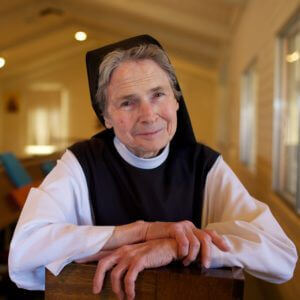
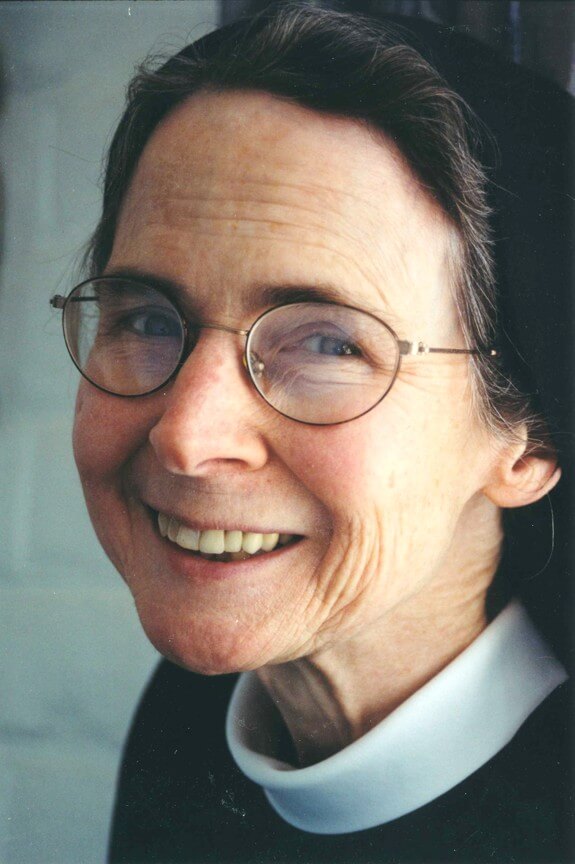
 Sister Miriam Pollard
Sister Miriam was born in New London, CT in 1933, the only child of Francis and Florence Pollard. She was baptized Elaine Frances a few weeks later. Her father was in the US Coast Guard and would serve in the North Pacific during WW2.
Sister Miri was not one to speak of herself; she was more interested in listening to others tell their stories. But we know that she learned to read at the age of four, and that she would stand up in the car between her parents and gaze out the windshield as they drove cross country.
Right there we glimpse the roots of her life-long love of words and love of nature. She looked deeply into the natural world and, fed by her Catholic faith, she discovered God’s own delight in his Word and in his creation. In the title poem of her collection, “Neither Be Afraid,” this daughter of the Coast Guard writes of salt wind, shores, and horizons lost to fog,
But fear? Not quite. A pricking of the skin,
a curiosity, a hope, a fierce and lonely
sense that form, like truth, cannot dissolve,
and, for this little while, is hidden only,
that still, somewhere, the promontories are,
the punctual tides, the tall ships, and the morning star.
What drew her after college and teaching 3rd grade to the newly founded Mt St Mary’s Abbey in the quiet town of Wrentham, MA? The Bridegroom, the Father, the Comforter. The mystery of Incarnation, of angels “chanting like sea bells / in places of no horizon”, the Storm King “in his garment of dust”, the “Thunderer / drumming in a heart of flesh”. I’m tempted to stand here and read you her entire poetry book, for it is all here, in these luminous words, in these brave imageries: the red bird who sings and is itself sung on the wounded palms of its lover who “died when the sun fell down and the night licked up the sea”, this red bird, our Miri, who now sees “my love in a long white robe and a crown of jubilee”.
She entered monastic life in 1956 and lived forty years at our motherhouse. No doubt she worked in the dairy barn and the candy house. An artist with pen and brush, her gifts were discovered and given expression in the art department. She also wrote both prose and poetry. Her four published volumes touched many people beyond the monastery with her insightful wisdom.
I first met her in the summer of 1994 when Wrentham invited the juniors of its three daughter houses for two weeks. Sr Miri was vocation director and lectio divina teacher, composer of hymn texts and typist of melodies.
In 1996 she was called to Redwoods Monastery (another coast-to-coast journey) to assist that community through a painful season. Her poem “Northwest Autumn” clearly dates from that time with its “redwood needles” drifting down “like copper snow” and “walls of rain” which “build houses for the heart”, a “winter world” that is “instinct with redemption” and where “Christ is blazing in the starless night.”
In May of 2000, two years after she returned to Wrentham, we elected Sr Miriam to be our prioress. And so once more she crossed this vast North American continent. Mother Beverly, our prioress since 1990, lay dying in our infirmary. Mother Miriam walked with each of us down that road of letting go and grieving. She who had a way with words also had a way of listening that was healing and gave us courage to walk on into the future together.
She was practical, too. Signed herself up to work half-days in the altar bread bakery to get out of the prioress’ office and get to know us as we worked. She obtained a new walk-in freezer for the monastery kitchen. Accompanied us through the hard years while four solemnly professed sisters, one at a time, discerned a call elsewhere. She saw to the construction of what was dubbed “the art building” and to the extensive renovations which repurposed existing spaces. (We Trappists with our vow of stability love to repurpose rooms and even whole buildings!) And then there was the crafting of a new website. And last in this list, but certainly not least, she fed us with the prose-poems that were her meditations on the Gospels, meditations she named “homilets” (rhymes with “omelets”).
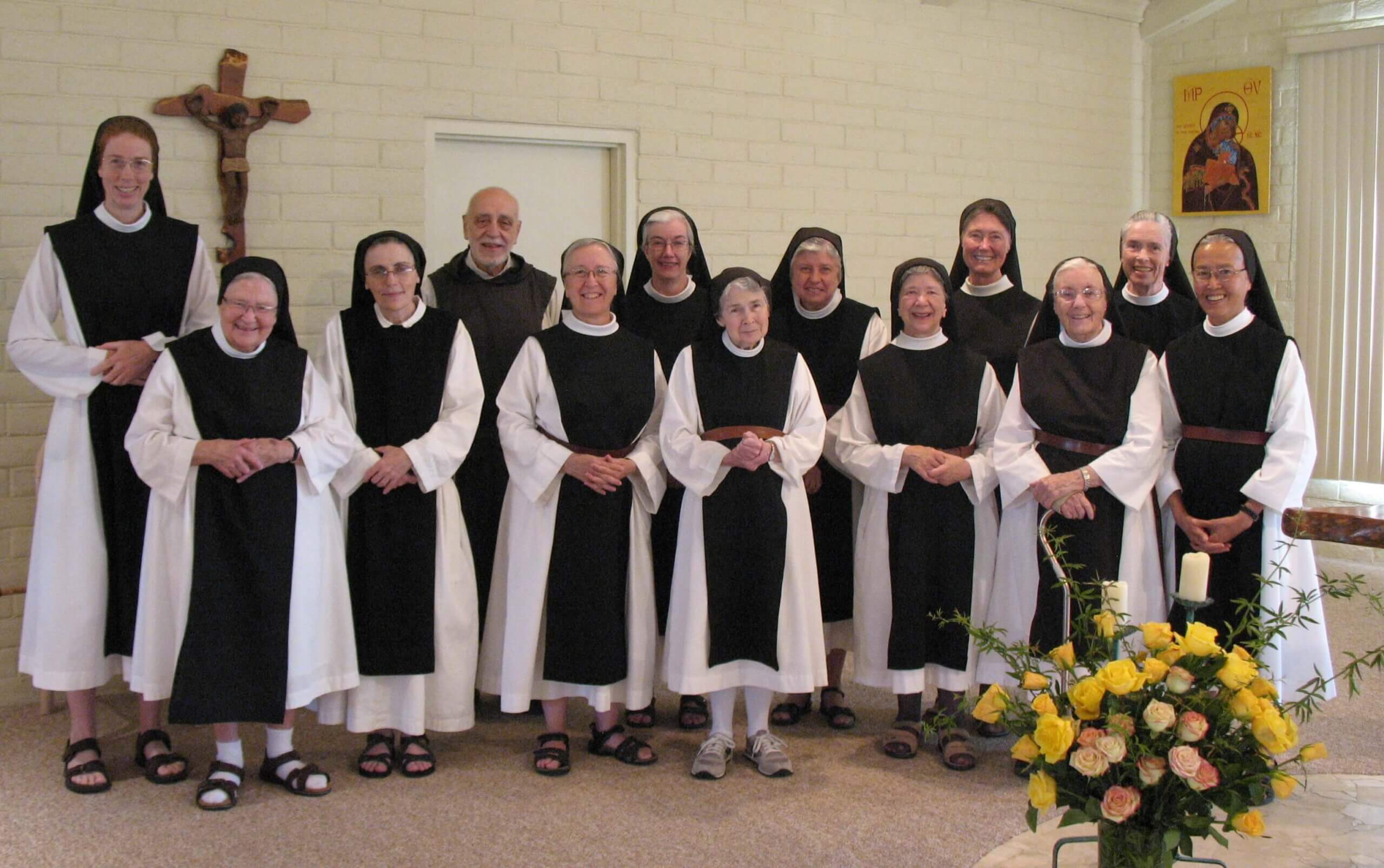
In 2006 we re-elected Mother Miri for a second six-year term, even though in 2008 she would turn seventy-five and be obliged to offer her resignation to the abbot general in Rome. We petitioned him to allow her to continue in office until 2012. How blessed we were to have her in what our Order calls “the service of authority.” A service, indeed; a life given in faith and love for the sake of the One who called her from the seashore to a cloister in the New England woods, to a second monastery among the majestic Redwoods, and finally to this place in a wide grassy valley under a wide sky, to this little desert community named Our Lady of the Santa Rita Mountains.
Mother Miriam retired in 2012, and we elected Sr Vicki – Vicki who in 1972 had been the 25-year-old novice in our group of six foundresses. Sister Miri chose to stay right here in her adopted community of Santa Rita, where she continued to love and to serve but in new, less burdened ways. Mother Vicki entrusted her with the next reinvention of our website and with our library. She baked altar breads until she was 80, but continued working on the bakery’s quality control crew until she was 91.
The year she turned 80 proved a hard one: a series of medical events precipitated the long, slow decline of her last twelve years. How painful it was for us to witness this brilliant woman of God lose her way with the written word. How much more painful it was for her! And yet she hung in there. She remained “Miri”. The light stayed alive in those quiet eyes and in that quiet voice. In community dialogues she might not say much, but when she did, it was straight to the point.
The last two years were the hardest. We so wanted to keep her home in the monastery, but the time came when the care she most needed could not be provided here. The transition from the quiet countryside cloister to the noisy city-side nursing home was not at all easy. Even the best of nursing homes is a shock to the system! It helped that our Sr Clare was already in residence – at least there was one familiar face in that alien world. Yet she found community there, too. And there she was, that kind and quiet soul, listening once again to people’s stories.
Now I’ll let Sr Miri have the last word with an excerpt from her long broken-line meditation entitled “Holy Saturday”. The speaker here is waiting in the dark tomb where Jesus’ body lies dead, waiting, and slowly learning to be in the present, to just be there, content to wait.
Waiting is what you have become,
and what you are content to want.
It is quietness
and – though you hate to concede the word –
a species of love.
To wait is to expect,
and not demand.
To wait is to be content to wait.
Sound when it comes
does not surprise you.
The grating of stone on stone is part of the waiting.
The crack of gray light that begins to dilute
your darkness
is not an event.
And then the stone rolls back,
and you see that the slab is empty,
and day walks into the tomb,
and you climb the steps into a dewy morning.
The gardener is stooping over his plants.
He is singing to himself.
Can you see him now? Straightening up, turning to her, and calling her by name? Perhaps he says to her, (if I may take liberties with words from yet another poem), “Come, Miri, come home with me to the Father, to the deep secret of your heart …”
– M. Pam Fletcher –