“יְהוָ֥ה אֱלֹהֵ֖ינוּ יְהוָ֥ה אֶחָֽד”
(The LORD is our God, the LORD Alone.)
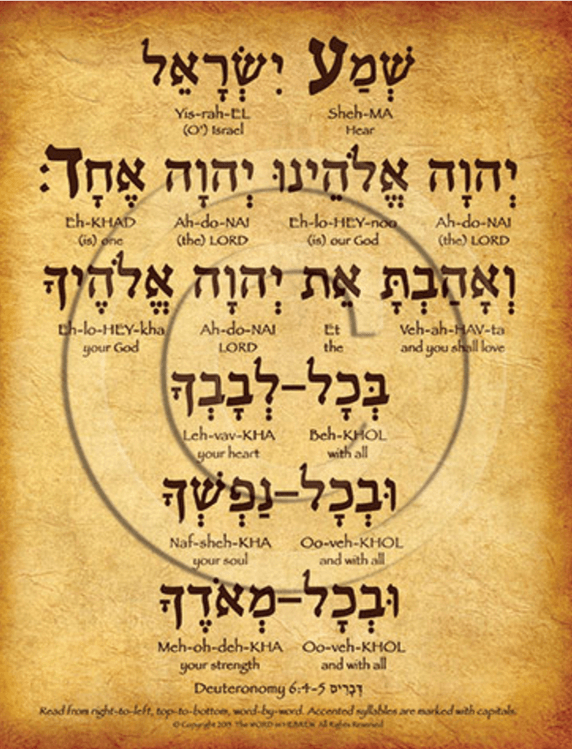
“וְאָ֣הַבְתָּ֔ אֵ֖ת יְהוָ֣ה אֱלֹהֶ֑יךָ בְּכָל־ לְבָבְךָ֥ וּבְכָל־ נַפְשְׁךָ֖ וּבְכָל־ מְאֹדֶֽךָ׃”
(And you shall love the LORD your God with all your heart and with all your soul and with all your strength.) (Deu 6:4-5)
“וְאָהַבְתָּ אֵת יְהוָה אֱלֹהֶיךָ”(Ve’ahavta et Adonai Eloheikha)
You shall love the LORD your God.
“בְּכָל־לְבָבְךָ”(bekhol levavekha)
With all your heart
Heart (לְבָב, Levav)
In the Bible, the heart is more than emotion. It is the center of decision, will, and purpose. Jewish tradition asks why the text uses levav rather than the shorter form lev.
The rabbis answered: “Love God with both of your hearts.”
That is, with your good inclinations and your broken ones, with faith and doubt, with courage and fear, with your whole conflicted and divided self.
God desires not only the best parts of us, but our entire heart.
“וּבְכָל־נַפְשְׁךָ” (bekhol nafshkha)
And with all your soul
Soul (נֶפֶשׁ, Nephesh)
The Hebrew word nephesh does not simply mean an immortal soul. It refers to the whole living person. To love God with all your soul is therefore to entrust your entire life to Him:
your daily routines, your work, your relationships, your joys and sorrows, your successes and failures.
It is an invitation for the whole of life to turn toward God.
“וּבְכָל־מְאֹדֶךָ” (uvkhol me’odekha)
And with all your strength
Strength (מְאֹד, Me’od)
Surprisingly, me’od does not originally mean “strength.” In Hebrew it is usually an adverb meaning “very,” “greatly,” or “exceedingly.” Taken literally, the phrase could be translated: “With all your very-ness.”
Love God with all your abilities, all your resources, all your energy, all your passions, all your gifts, all your tears.
Love God with the fullest measure of your being.
The greatest commandment may therefore be summed up in these words:
“Live in God with everything you have and with every way in which you exist.”
Why?
Because this is our deepest fulfillment and our true happiness.
It reveals who we are. It reveals why we exist.
And above all, because God first loved us with all His heart, all His soul, and all His strength.
Saint Augustine wrote:
Amor meus, pondus meum.
“My love is my weight.”
What ultimately moves our lives is not what we think, but what we love. We always move toward what we love.
Therefore the deepest question is:
* What do I truly love?
* Toward what do I naturally gravitate?
That is my love. And that is my destiny.
The greatest commandment is not a demand to become perfect before loving God. It is an invitation to turn toward Him, with the two hearts of levav, with the fragile life of nephesh, with all the “very-ness” of me’od. Little by little. One turning at a time.
“שְׁמַע יִשְׂרָאֵל”
“Hear, O Israel!”
“To fall in love with God is the greatest of all romances;
to seek Him, the greatest adventure;
to find Him, the greatest human achievement.”
– Fr. Raphael Simon, monk of Spencer Abbey –